
Universal, Targeted or Specialist? Who Gets What?

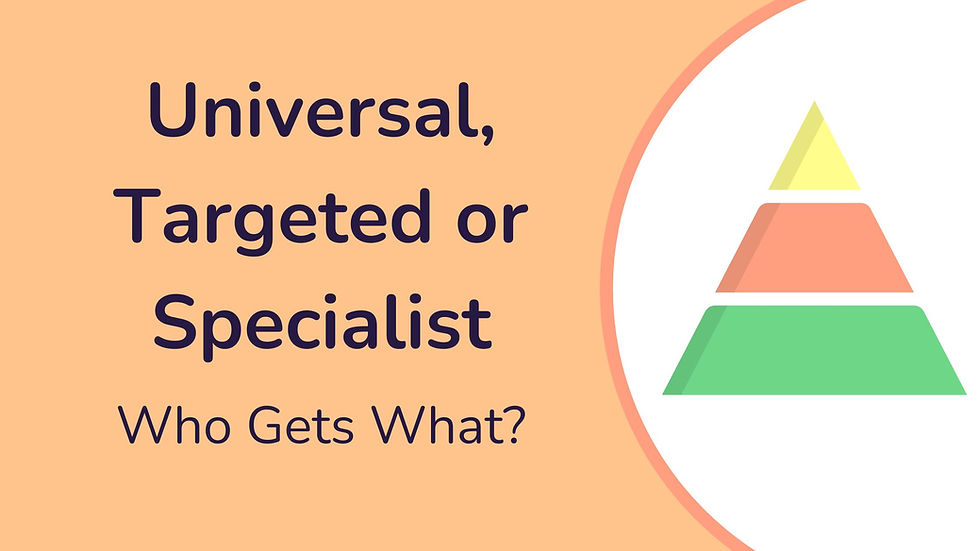
When we're talking about supporting children with speech, language and communication needs, we use words like universal, targeted and specialist all the time.
But what do they actually mean in practice?
And, more importantly, how do you know whether the support you're providing is at the right level for the children you're working with?
It can be tempting to think of the three levels as a simple progression ladder (or pyramid as we often see in training):
Universal → Targeted → Specialist
But in reality for schools, things aren't always quite that neat.
The important thing is having a clear pathway between the different levels in your setting, so that children receive support that is appropriate to their needs and staff understand what their role is at each stage.
1. Universal provision: what should every child experience?
Let's start with universal provision.
This is the support that should be available to every child, whether or not they have identified speech, language or communication needs.
For Speech Language and Communication Needs (SLCN), that means thinking about what communication looks and sounds like in everyday classrooms.
Are adults:
giving children enough processing time?
using clear, accessible language?
checking that children have understood instructions?
adapting their questioning?
using visuals or other scaffolding where appropriate?
modelling language?
creating opportunities for children to talk and communicate?
These aren't necessarily special interventions for children with SLCN, they're things that can make teaching and learning more accessible for everyone. And that's important because strong universal provision should be the foundation on which everything else is built.
2. Targeted provision: what happens when universal support isn't enough?
Some children will need something additional to the support they're already receiving as part of everyday classroom practice. That's where targeted provision comes in.
The key question isn't simply:
"Which children need an intervention?"
It's:
"What does this particular child need that isn't already being provided universally?"
Targeted support might involve additional opportunities to practise a particular skill, a small-group intervention, specific strategies used consistently by staff, or additional support linked to an identified area of need.
But whatever the provision looks like, it needs to have a purpose.
What are you trying to help the child develop? This could be speech sounds, vocabulary recall, memory skills, for example.
Why have you chosen this particular support? Is it because it’s evidence-based to be effective, is it an age-appropriate intervention?
Who is going to deliver it? A Teaching Assistant in. A small group, or by the teacher in the classroom setting?
How often? Daily? Twice per week? For 10 minutes or 30?
And how will you know whether it is helping? What systems are in place to track and monitor the impact of the support?
Targeted provision shouldn't sit completely separately from what's happening in the classroom either.
Ideally, there should be a connection between the additional support a child receives and their everyday experience of teaching and learning.
3. Specialist support: when is additional specialist input needed?
Then there are children whose needs require specialist assessment, advice or intervention. This might involve a speech and language therapist or another specialist professional, depending on the child's needs. But specialist involvement doesn't mean that school staff step out of the picture completely. In fact, the opposite is often true. Specialist advice is most useful when it can be understood and implemented by the people who work with the child every day.
A speech and language therapist might assess a child's speech, language or communication and recommend particular strategies or intervention. The child's teachers and support staff then have an important role in putting that advice into practice and supporting the child in their everyday environment.
Specialist support should sit alongside what school staff are doing, rather than replacing it.
In the clinical work that I do, I’m often asked to assess children and then provide intervention, for example speech sounds. I’ll see a child for a block of speech therapy sessions and also send work home and to school for continuation, extra practise and to maintain the progress made each week. Then there’ll be a report with advice and strategies going forward. This can be specialist and also targeted, depending on the needs of the child.
4. The important part: the levels need to connect
This is probably the bit I think about most when I'm working with schools.
It isn't really about deciding whether a child is a universal, targeted or specialist child.
Children shouldn’t be defined by their label or category. Their needs can change, and the support they need can change with them. Instead, it’s better for a school to be able to show a clear pathway:
What is happening for everyone?
↓
Who needs something additional?
↓
What additional support are they receiving?
↓
What difference is it making?
↓
What needs to change, continue or be escalated?
And if specialist advice is needed, how does that fit into the support already being provided?
The aim isn't to have lots of children receiving specialist intervention or to refer to outside agencies whenever there is a concern. Especially when criteria for access to those agencies and professionals is specific and waiting lists are long.
Equally, we don't want children who need additional or specialist support to get stuck at universal level because nobody is quite sure what to do next.
The different levels need to work together.
5. Questions for school leaders and SENCos to ask
If you're reviewing your school's approach to SLCN, it might be useful to ask:
At universal level:
What communication-supportive strategies should every member of staff be using?
Are these strategies genuinely part of everyday practice?
Would staff be able to explain what good communication support looks like in their classroom?
At targeted level:
How do we identify children who need something additional?
What does our targeted provision actually look like?
Is it matched to the child's needs?
Who delivers it?
How is it monitored?
At specialist level:
When do we seek specialist advice?
Do staff understand how to implement specialist recommendations?
How do we make sure specialist input becomes part of the child's everyday experience rather than something that happens separately?
And perhaps the biggest question of all:
Can staff explain what happens next when a child isn't making progress with the support they're currently receiving?
That’s a school inspector type of question 👆.
6. Where does your school sit right now?
You might find that your school has some really strong elements already. Perhaps your universal provision is well embedded, but staff aren't always sure what targeted provision should look like.
Maybe you have lots of targeted interventions, but you're not always clear about whether they're making a difference.
Perhaps staff are very good at implementing speech and language therapy recommendations, but there isn't yet a consistent approach to identifying children who may need support in the first place.
Or maybe the provision is there, but it isn't consistent between classrooms.
These are all useful things to know. But you don't need to have everything perfect.
The important thing is knowing where your gaps are so that you can decide what to work on next.
7. What does good practice look like?
For me, the goal is a school where communication, like SEND in its entirety, is understood as part of everyone's job.
☑️ Where staff know what they can do at a universal level.
☑️ Where children who need additional support can be identified and given appropriate targeted provision.
☑️ Where specialist advice is understood and used.
☑️ And where there is a process for checking whether the support is actually helping.
That creates a much more joined-up approach to SLCN.
8. Want to look at your own provision?
If you're wondering how your school is doing across these different areas, start by asking your staff what they think.
Do they know how to recognise possible SLCN?
Do they know what they can do universally?
Do they know what targeted support is available?
Do they know when and how to seek specialist advice?
And do they know what happens after support has been put in place?
You may be surprised by the differences between what you think your school's approach is and what staff actually experience day to day. And that's useful information 🔍.
Because once you know where the gaps are, you can start working out what needs to happen next.
If building staff knowledge and confidence around SLCN is one of your priorities this year, take a look at my Training Package, which provides whole-staff online training and resources that staff can access throughout the year.

Hi I'm Beth Morrant, a Highly Specialist Speech & Language Therapist and I'm on a mission to help thousands of education and childcare settings to have trained-up staff who can confidently identify and support the wide range of speech, language & communication needs that children can have.


